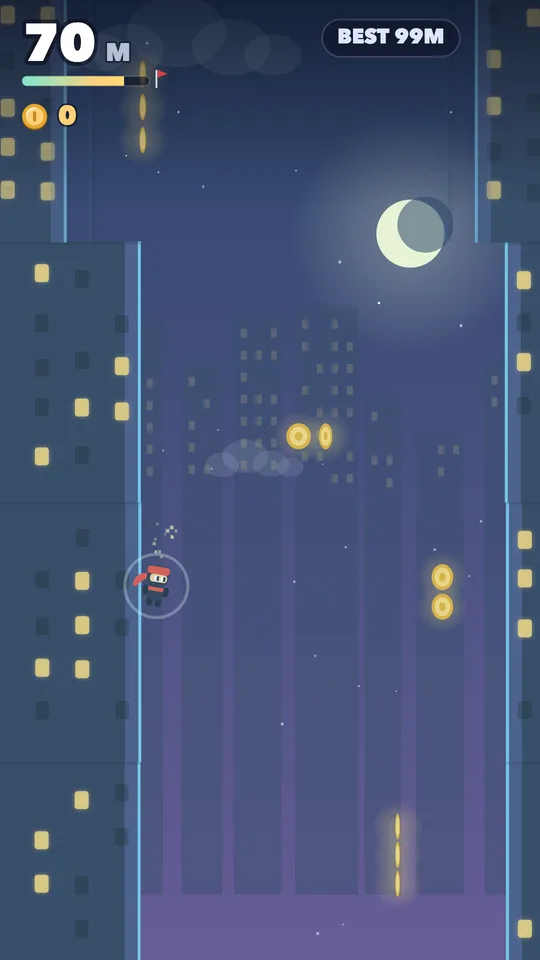
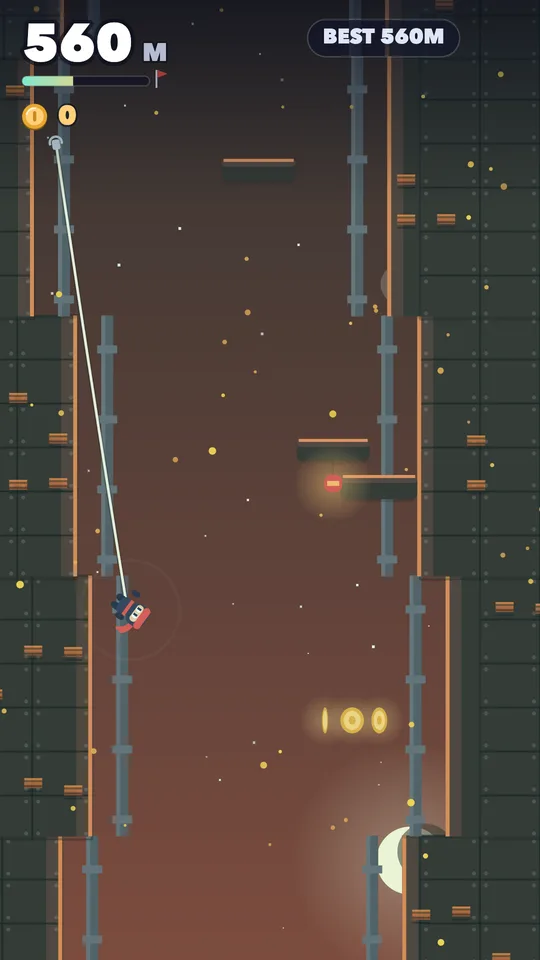
Understanding the physics of a rope swing game
Most arcade rope swing games rely on a simple physics principle: tension equals speed. When you attach a grappling hook to a wall, the distance between your character and the anchor point determines how much power you have. A short rope provides a quick, controlled hop, while a long rope allows for a massive, sweeping arc.
In games like Rope Ninja, the goal is to travel upward through an endless tower. Because the hook attaches to the side walls rather than the ceiling, your path will always be a zig-zag. To climb efficiently, you want to aim for the opposite wall at a high angle. The more horizontal distance the rope covers, the more 'snap' you get when you release, flinging you higher into the next section of the tower.
Mastering the 'Hold, Aim, Fly' technique
Precision is just as important as power. Modern climbers have moved away from 'blind' throws, offering players more data to make better decisions.
- Press and Hold: This initiates your aim. Don't rush this step. Unlike older arcade games that required twitch reflexes, Rope Ninja lets you hold your position while you line up the perfect shot.
- Read the Preview: Watch the trajectory line. The aim preview shows exactly where you will land. If that line turns red, it means a spinning blade or an obstacle is in your way.
- Release to Fly: Once the path is clear and the angle is steep, let go. Your character will follow the arc and stick to the new anchor point.
Navigating obstacles and hazards
The higher you climb, the more the environment works against you. A simple vertical shaft eventually fills with hazards that require more than just raw speed to bypass.
Dodging Blades
Moving saws and stationary blades are the primary run-killers. The trick is to wait for the blade to pass its center point before you initiate your swing. Use the 'hold' phase to wait out the hazard's movement cycle while watching the preview line.
Dealing with Birds and Bonuses
Not everything in the sky is a threat. Some games feature birds that can be knocked out of the sky for points or rockets that provide a temporary boost. In Rope Ninja, catching a rocket allows you to steer left and right for a few seconds, bypassing the need for ropes entirely and clearing massive distance quickly.
Managing your progression and equipment
As you get better at the mechanics, you will start collecting currency—usually coins found floating in risky positions. While it is tempting to dive for every coin, remember that one slip and it’s over. It is often better to prioritize a clean climb and collect coins that are naturally on your path.
These coins are used to customize your experience. In Rope Ninja, you can unlock:
- New Suits: Changes your character's appearance.
- Rope Trails: Leaves a visual path behind you as you swing.
- Boosts: Help you start higher or gain more coins per run.
All of these upgrades can be earned through gameplay. There are no forced ads to interrupt your flow, though you can choose to watch an opt-in rewarded ad for a 'second chance' if you fall during a high-score run.
Advanced tips for high-score runs
To reach the 'Golden Summit' or the later worlds like 'Aurora' or 'The Void,' you need to stay consistent.
- The 100m Rule: In Rope Ninja, the world changes every 100 metres. This often comes with a shift in visual clarity, such as the 'Downpour' or 'Frostline' effects. Adjust your focus as the background changes to ensure you don't lose track of the walls.
- The Daily Spin: Don't ignore daily rewards. Use the daily spin or the 'Daily Climb' challenge (with its seven-day rewards) to stockpile coins faster than standard runs.
- Stay Centered: While you have to swing wall-to-wall, try to keep your character from hugging the wall for too long. Sliding down costs you height. Aim your next shot the moment your hook bites the stone.