Understanding your mortgage payoff journey
For most Canadians, a mortgage is the largest financial commitment they will ever make. Tracking your progress is about more than just seeing a number go down; it is about understanding how much of your monthly payment is actually building equity. In the early years of a mortgage, a significant portion of your payment goes toward interest. As the principal decreases, more of your money goes toward the loan itself.
To effectively track mortgage payoff progress, you need to stay organized with three key pieces of data: your current balance, your amortization schedule, and your next renewal date. Unlike a simple savings account, a mortgage balance doesn't move linearly, and keeping a close eye on it ensures you aren't surprised when it comes time to renegotiate with your lender.
Step 1: Locate your baseline data
Before you can track progress, you need an accurate starting point. You can find these details in your lender's online portal or your most recent annual statement:
- Current Principal: The total amount you still owe.
- Interest Rate: Your current contract rate (fixed or variable).
- Amortization Remaining: How many years and months are left until the loan is $0.
- Maturity Date: The end of your current term when you must renew or pay off the balance.
Once you have these, you can calculate your home equity. Subtract your current principal from the estimated market value of your home. This number represents the portion of the property you truly own.
Step 2: Monitor interest versus principal
Every payment you make is split between interest (the cost of borrowing) and principal (the loan balance). If you have a fixed-rate mortgage, this split changes slightly every month. If you have a variable-rate mortgage with fixed payments, a rise in interest rates might mean more of your payment is going toward interest and less toward the principal.
Regularly checking this split helps you decide if you should make prepayments. Most Canadian mortgages allow for 'lump sum' payments or 'double-up' options. Tracking your progress helps you see the long-term impact of these extra payments, as they go directly toward the principal and can shave years off your amortization.
Step 3: Watch the market and renewal dates
In Canada, tracking mortgage payoff progress is closely tied to the renewal cycle. Most terms last five years, meaning you will likely renegotiate your rate several times before the mortgage is fully paid.
You should begin actively tracking market rates about six months before your maturity date. If rates have dropped since you signed your last contract, you may want to lock in a new rate early.
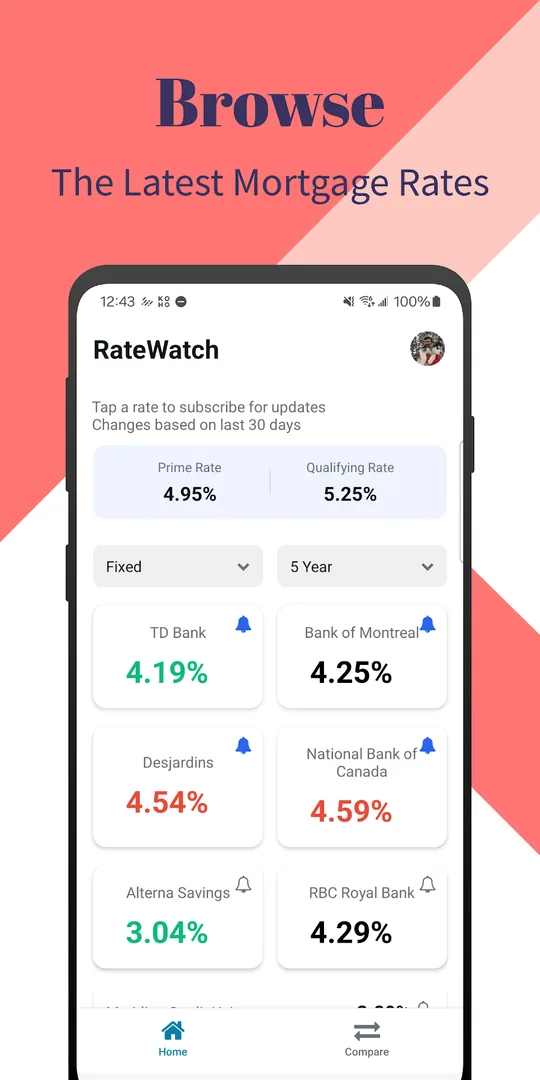
RateWatch helps you monitor these movements on Android. The app's Home screen displays today's posted rates from major Canadian lenders like RBC, TD, and Scotiabank, alongside the prime rate. Seeing these rates side-by-side helps you understand how your current payoff strategy compares to the broader market.
Step 4: Use a comparison tool for better terms
As you track your progress, you might find that other lenders are offering better terms than your current bank. When your renewal date approaches, don't simply sign the first offer your lender sends in the mail.
Use a comparison tool to look at fixed and variable rates across different terms (from 1 to 10 years). Even a small difference in rate can result in thousands of dollars saved over a five-year term. The Compare tab in RateWatch lets you view these lenders side by side, making it easier to spot which institutions are currently offering more competitive posted rates for your next term.